Industry knowledge
How Pole Count and Step Angle Are Determined in Stepper Motor Design
The step angle of a stepper motor is directly governed by the number of rotor teeth and stator poles. The standard formula is:
Step Angle = 360° / (Number of Rotor Teeth × Number of Phases)
For a typical 2-phase hybrid stepper motor with 50 rotor teeth, this yields a 1.8° full-step angle — the most common standard in industrial automation. Half-stepping halves this to 0.9°, and microstepping can further reduce it to fractions of a degree for smoother motion profiles.
Key relationships buyers should understand:
- More rotor teeth = finer step resolution, but also higher magnetic frequency at speed, increasing iron losses
- Higher pole count improves holding torque density but demands tighter lamination stamping tolerances
- The air gap between stator and rotor teeth — typically 0.02–0.05 mm in precision cores — critically affects both torque output and positional accuracy
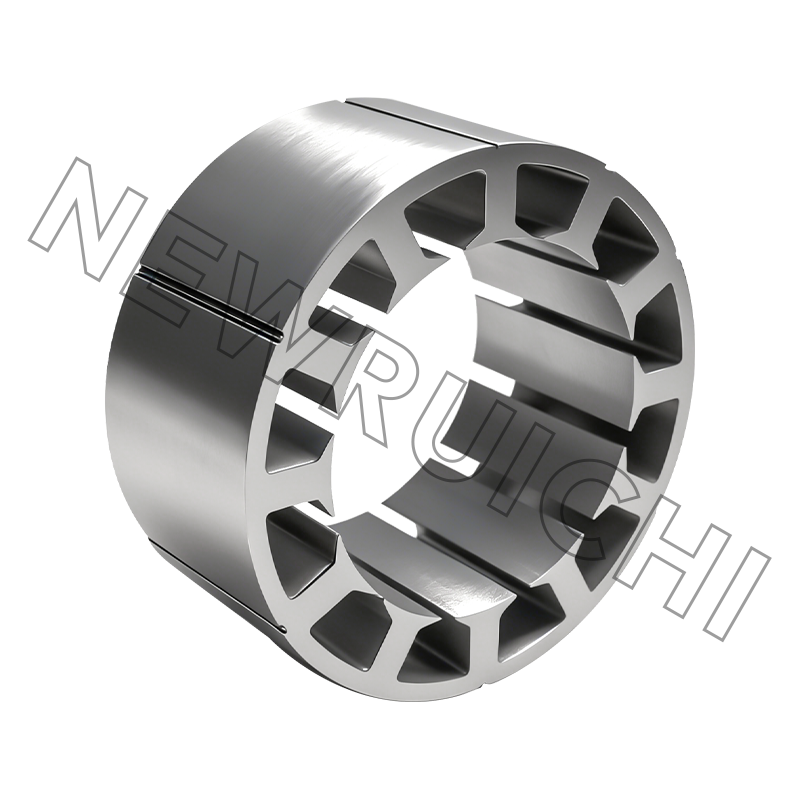
This is why stepper motor stator and rotor core dimensional consistency matters so much: even minor variation in tooth geometry across a production batch translates directly into torque ripple and positioning error downstream.
Lamination Material Selection: Silicon Steel Grades and What They Mean for Performance
The stator and rotor core laminations are punched from electrical silicon steel, and the grade chosen has a significant impact on motor efficiency, heat generation, and high-speed behavior. The two primary categories are:
Common silicon steel grades used in stepper motor stator/rotor cores
| Grade |
Thickness (mm) |
Core Loss (W/kg @ 1T, 50Hz) |
Typical Application |
| 50W470 |
0.50 |
≤4.7 |
General-purpose, cost-sensitive |
| 35W300 |
0.35 |
≤3.0 |
Higher speed, efficiency-focused |
| 20W1500H |
0.20 |
≤1.5 |
High-frequency, precision robotics |
Thinner laminations reduce eddy current losses at high switching frequencies — a particularly relevant consideration for motors used in humanoid robot joints and UAV actuators, where operating frequencies often exceed 400 Hz. However, thinner stock increases per-piece stamping cost and requires more precise die maintenance to avoid burr formation that degrades stacking factor.
Our production covers the full range of these grades, allowing us to recommend the right material balance for your torque density, thermal, and cost targets — rather than defaulting to a single specification across all applications.
Stacking Factor, Insulation Coating, and Their Effect on Actual Core Performance
A lamination stack is never 100% steel — the insulating coating between layers occupies a measurable portion of the total stack height. Stacking factor (also called fill factor) expresses the ratio of actual steel volume to total core volume, typically ranging from 0.93 to 0.98 for well-produced cores.
Why this matters in practice:
- A lower stacking factor reduces effective magnetic cross-section, directly reducing flux density and thus torque output for a given winding
- Burrs from worn stamping dies physically prevent laminations from lying flat, compressing the stacking factor unpredictably across a batch
- Coating thickness must be uniform; inconsistent coating causes localized inter-lamination shorts, raising core temperature during operation
Common Insulation Coating Types
- C-2 (inorganic): Good heat resistance, used in high-temperature industrial motors
- C-5 (organic/inorganic composite): Excellent punchability, self-bonding variants available for bonded-stack cores
- C-6 (self-bonding): Activated by heat after stacking — eliminates welding or riveting, reduces vibration and acoustic noise, increasingly specified in precision motion applications
For buyers sourcing cores for noise-sensitive or high-precision environments such as medical devices or collaborative robots, specifying C-6 self-bonding laminations is worth the modest cost premium.
Evaluating Supplier Core Quality: Inspection Dimensions That Actually Predict Motor Performance
When qualifying a stepper motor stator and rotor core supplier, standard dimensional checks (OD, ID, stack height) are necessary but insufficient. The following parameters have a more direct relationship to assembled motor performance and are worth explicitly requiring in your incoming inspection or supplier audit:
- Tooth pitch uniformity: Measured via CMM or optical comparator across all teeth. Variation >0.01 mm contributes to detent torque irregularity and positional error.
- Concentricity of bore to OD: Affects air gap consistency after assembly. Typical tolerance for precision grades: ≤0.02 mm TIR.
- Burr height on lamination edges: Should not exceed 0.05 mm; excessive burrs compromise stacking factor and can damage winding insulation.
- Core loss measurement on finished stack: Per IEC 60404-2, using an Epstein frame or single-sheet tester. Confirms actual material grade delivered matches specification.
- Stack height consistency across a batch: Variation indicates inconsistent lamination thickness or coating — both upstream material issues that affect inductance and back-EMF uniformity.
With over 80,000 square meters of integrated manufacturing capacity, we maintain in-house tooling, stamping, and quality inspection across the full core production chain — which is precisely what allows us to hold these tighter parameters consistently across volume orders, not just qualification samples.

 en
en
 русский
 Deutsch



 Email:
  Telephone/Phone:
