 en
en
 русский
 Deutsch
Oriented Silicon Steel Coil: Full Guide
Content
- 1 What Is Oriented Silicon Steel Coil and How Is It Made
- 2 Key Magnetic Properties and Why They Matter
- 3 Standard Grades and Thickness Selection
- 4 How Slitting and Cross-Cutting Quality Affects Final Core Performance
- 5 Applications Where Oriented Silicon Steel Coil Is the Right Choice
- 6 What to Verify When Sourcing Oriented Silicon Steel Coil
What Is Oriented Silicon Steel Coil and How Is It Made
Oriented silicon steel coil, also known as grain-oriented electrical steel (GOES), is a specialized soft magnetic material produced by introducing silicon into iron at a controlled ratio, typically between 2.9% and 3.5%, and then processing the alloy through a carefully sequenced cold-rolling and high-temperature annealing cycle. The defining outcome of this process is a crystallographic texture in which the grains of the steel align along a single preferred magnetic direction, known as the Goss texture. This alignment is what separates oriented silicon steel from non-oriented silicon steel and gives it fundamentally different performance characteristics.
The manufacturing sequence begins with hot rolling to reduce the steel slab to an intermediate thickness, followed by one or more cold-rolling passes that progressively refine the grain structure. A final decarburization and high-temperature annealing step at temperatures above 1100 degrees Celsius locks in the grain orientation and removes carbon impurities that would otherwise increase core loss. The finished coil is then coated with a thin insulating layer, typically a magnesium silicate-based glass film combined with a tension coating, which serves both to electrically isolate adjacent laminations and to introduce beneficial compressive stress that further lowers hysteresis loss.
Key Magnetic Properties and Why They Matter
The value of oriented silicon steel coil in electrical equipment rests on three measurable magnetic properties: core loss, magnetic permeability, and magnetic flux density. Each of these directly influences how efficiently a transformer or generator converts and transmits energy, and each is sensitive to the quality of the coil stock used to stamp the laminations.
Core loss, expressed in watts per kilogram at a defined flux density and frequency, is the primary selection criterion for transformer designers. It has two components: hysteresis loss, which arises from the energy consumed each time the magnetic domains reverse direction during an AC cycle, and eddy current loss, which results from circulating currents induced within the steel by the changing magnetic field. Grain orientation reduces hysteresis loss by making domain reversal energetically easier along the rolling direction. The elevated silicon content raises electrical resistivity and suppresses eddy currents. Together, these effects produce core loss figures that are 30% to 50% lower than those achievable with non-oriented grades of comparable thickness.
High magnetic permeability means the material reaches its working flux density at a lower magnetizing force, which reduces the magnetizing current drawn by the transformer and improves power factor. This is particularly important in large power transformers operating continuously at or near full load, where even small efficiency gains accumulate into significant energy and cost savings over the service life of the equipment.
Standard Grades and Thickness Selection
Oriented silicon steel coil is graded primarily by core loss, with lower values indicating higher grade material. The naming convention used in most international standards encodes both thickness and core loss into the grade designation. Selecting the right grade requires matching the material's performance to the operating frequency, flux density, and efficiency target of the end application. The table below summarizes the most commonly used grades and their typical applications.
| Grade | Thickness (mm) | Max Core Loss (W/kg) | Typical Application |
| 23QG090 | 0.23 | 0.90 | High-efficiency power transformers |
| 27QG095 | 0.27 | 0.95 | Power and distribution transformers |
| 30QG105 | 0.30 | 1.05 | Distribution transformers, ballasts |
| 35QG135 | 0.35 | 1.35 | Small transformers, reactors |
Thinner gauges deliver lower eddy current loss and are the correct choice for higher-frequency applications, but they increase the number of laminations required per unit stack height and add stamping complexity. The efficiency gain must therefore be weighed against tooling wear, die clearance requirements, and the per-kilogram price premium that thinner material carries.
How Slitting and Cross-Cutting Quality Affects Final Core Performance
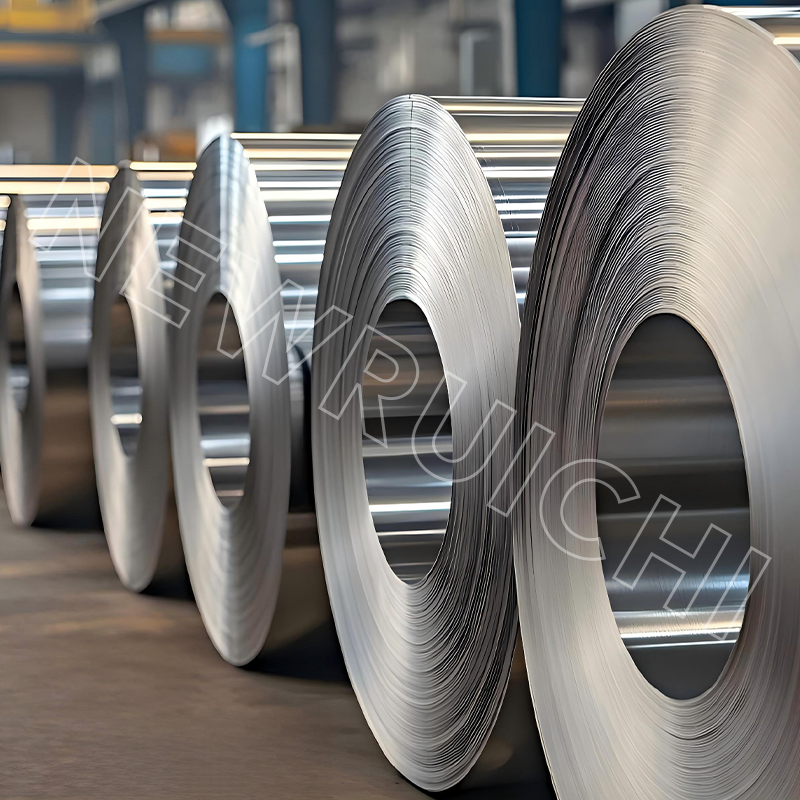
Oriented silicon steel coil reaches the lamination manufacturer in master coil widths that must be processed into narrower strips or cut-to-length sheets before stamping. Professional slitting and cross-cutting are not secondary operations. They directly determine whether the electromagnetic performance established at the mill is preserved through to the finished core.
During slitting, the coil is passed through rotary knives that divide it longitudinally into strips of the required width. Blade sharpness, knife gap, and lateral pressure must be controlled precisely. Excessive burr height on slit edges introduces mechanical stress into the steel adjacent to the cut, which disrupts the grain structure and locally elevates core loss. In transformer laminations where the flux path runs close to the strip edge, this effect is measurable in the finished core. Well-executed slitting produces edge burr heights below 10% of material thickness and leaves the insulating coating intact to within a consistent distance from the cut.
Cross-cutting, which divides the coil or slit strip into individual sheet lengths, introduces similar risks at the cut ends. Shear blade alignment and clearance settings must be matched to the material thickness and temper to avoid edge cracking or excessive deformation. Flatness after cutting is also critical: sheets with residual coil curvature or waviness cannot be stacked to a consistent height, and uneven stack pressure during core assembly leads to vibration and acoustic noise in service.
As a supplier that handles both oriented and non-oriented silicon steel with in-house slitting and cross-cutting capability, consistent electromagnetic performance and flatness are maintained across every coil and sheet prepared for customers. This means procurement teams receive material that is ready to feed directly into stamping lines without requiring additional correction or sorting.
Applications Where Oriented Silicon Steel Coil Is the Right Choice
The directionality of oriented silicon steel means it performs best in applications where the magnetic flux follows a fixed path and the designer can align the laminations so that the rolling direction coincides with the flux direction. The following applications consistently benefit from oriented silicon steel coil.
- Power transformers: Large step-up and step-down transformers in transmission and generation facilities operate continuously at high flux densities. The low core loss of oriented silicon steel directly reduces no-load losses, which run around the clock regardless of load level.
- Distribution transformers: Pole-mounted and pad-mounted distribution transformers are deployed in enormous numbers across utility grids. Even modest reductions in per-unit core loss multiply into substantial grid-wide energy savings, making oriented silicon steel the standard material choice for this application.
- Instrument transformers: Current transformers and voltage transformers require accurate signal reproduction over a wide range of load conditions. The high permeability of oriented silicon steel at low flux densities supports the measurement linearity these devices demand.
- Reactor cores and inductors: Applications requiring high inductance with low loss at power frequency benefit from oriented grades, particularly where core volume and weight are constrained.
- Transformer lamination cores for specialty equipment: Audio transformers, welding transformers, and traction transformers each impose specific performance requirements that oriented silicon steel satisfies more reliably than non-oriented alternatives.
What to Verify When Sourcing Oriented Silicon Steel Coil
Sourcing oriented silicon steel coil from a supplier that understands both the material and its downstream manufacturing context reduces quality risk and simplifies the supply chain. The following checklist covers the verification points that experienced procurement and engineering teams prioritize before committing to a source.
- Mill certificate traceability: Each coil should be accompanied by documentation linking it to a specific mill heat, confirming the declared grade, thickness, and core loss test results.
- Coating integrity: The insulating coating must be continuous and free from scratches or delamination that would compromise inter-lamination resistance in the assembled core.
- Thickness tolerance: Verify that the supplier holds thickness variation within the tolerance band specified in the relevant standard, as excessive variation directly affects lamination factor and stack height predictability.
- Grain direction marking: Oriented silicon steel coil must be clearly marked to indicate the rolling direction so that laminations are stamped and stacked with the correct grain orientation relative to the flux path.
- Packaging and handling standards: Coils that arrive with transit damage, excessive moisture exposure, or mechanical deformation to the outer wraps introduce material that cannot be used reliably at the affected sections.
Working with a supplier that combines silicon steel material supply with direct experience in stamping and core manufacturing closes the information gap that often exists between material specification and production reality. When the supplier understands what the incoming coil actually needs to do on a stamping line and inside a finished core, the guidance provided during sourcing is grounded in operational knowledge rather than theoretical specification alone.
Your email address will not be published. Required fields are marked *


 Email: [email protected]
[email protected]
 Telephone/Phone:
+86-18861576796 +86-18261588866
Telephone/Phone:
+86-18861576796 +86-18261588866
+86-15305731515 +86-18861576796
Copyright © Wuxi New Ruichi Technology Co., Ltd. / Wuxi Cailiang Machinery Co., Ltd. All rights reserved.
Stator And Rotor Cores Manufacturers
